Shopping Cart
How to Teach Children to Use the Potty: Tips and Helpful Books
How to Teach Children to Use the Potty: Tips and Helpful Books

Around the age of two, parents face one of the most challenging moments in a child’s early life: learning to use the potty. Many wonder how to remove the nappy in the calmest, least stressful way possible.
The transition from nappy to potty is delicate because the child must suddenly learn to do something previously instinctive in a new, more conscious way. Think about it: from the first months, children often hear parents or grandparents talk enthusiastically about poop—how many times are we happy when a newborn has a bowel movement? Then, suddenly, we tell them they must no longer go in their nappy. The child does not understand, as they cannot see the logic behind the change. Suddenly, “poop” becomes a source of tension.
But why is it sometimes so difficult for a child to use the potty? For them, urinating or defecating feels like letting go of a piece of themselves. If there are misunderstandings with parents or the child does not feel safe releasing part of themselves, the process may be blocked. When done calmly, however, it can feel like the child is communicating their love, implicitly saying: “I give you a part of me because I know it will make you happy.”

Tips for Transitioning from Nappy to Potty
It is important to establish a positive relationship with the potty through a series of small strategies:
-
Use proper names: Call poop and pee by their actual names rather than nicknames or euphemisms. Joke about it, observe it in books or reality: children are naturally curious about what comes from their bodies, and this helps them ask questions about how it is formed, what space it occupied, its material, and its smell.
-
Reassure about disappearance: Since children view their poop as a part of themselves, they may fear it disappears and ask: “Where does it go when I flush? Is it okay? What happens to it? What if I don’t want it to disappear?” Guide children through this process creatively and playfully, reassuring them that their poop will be fine.
-
Learning through imitation: Children learn a lot by imitation. Seeing siblings, parents, or friends at school use the potty can be a great motivator for them to do the same.
-
Avoid criticism: Never accuse a child of laziness or embarrass them for difficulties. It is crucial that they feel comfortable using the potty. Instead, praise their other achievements while gently guiding them through potty training.

A Book to Help Learn the Potty
Applying all these tips can seem challenging, especially if parents are unsure how to proceed. Books can be a great support.
-
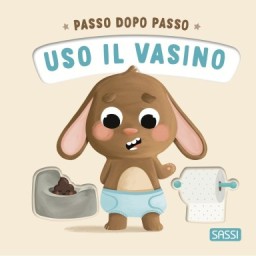
Step by Step: I Use the Potty: a board book written in collaboration with Paola Segantin, a teacher and pedagogy expert. The story follows Little Hare, allowing children to relate to the protagonist and understand that there is nothing wrong with using the potty. It also helps parents observe Mummy and Daddy Hare to learn how to manage different dynamics that may arise.
No matter how your child approaches the transition from nappy to potty, it is important to remember that it is a new experience for them, with all its challenges and mishaps. Responding to minor accidents with laughter rather than worry or disappointment fosters a healthy foundation for understanding their body and its needs.
We thank Paola Segantin for her invaluable advice, which inspired this article.
https://www.youtube.com/embed/LptnLmFxc0I?si=3v3XH1Yu7TkUkcjm
Related product
Passo dopo passo. Uso il vasino
Old price: €12.90
Price: €10.32
Discount: 20%
Save up: -€2.58
Un libro cartonato dedicato ai bambini più piccoli che, seguendo la storia di...